


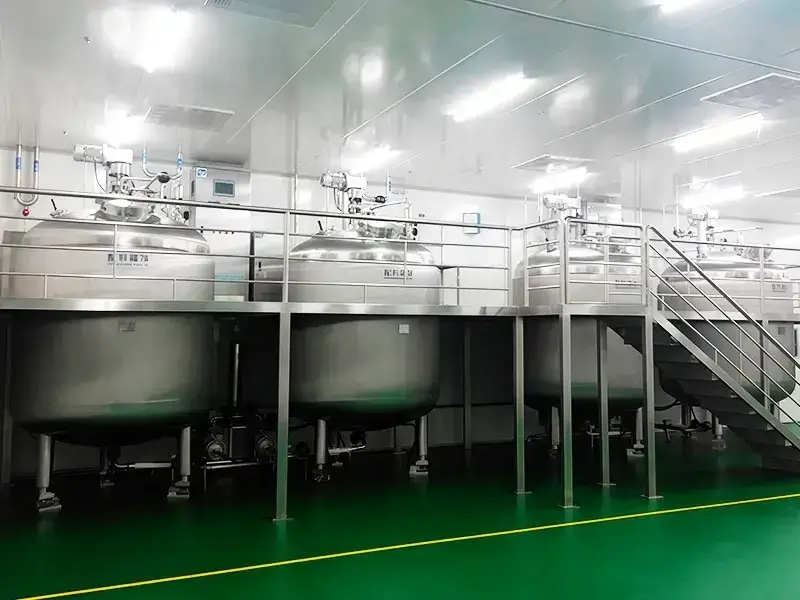
Purified Water System (PW Generation System)
The purified water (PW) generation system uses advanced reverse osmosis technology to remove impurities, bacteria, viruses, and other harmful substances from feed water. By producing safer and cleaner purified water, the system helps pharmaceutical manufacturers maintain reliable water quality for production and downstream processes.
Reverse osmosis membrane separation is the core process used in the purified water (PW) generation System. Under pressure, water containing molecules and particles of different sizes passes through a semi-permeable membrane. Because the membrane has selective permeability, it allows water molecules to pass through while retaining dissolved salts, impurities, microorganisms, and other unwanted substances.
This separation process helps produce stable purified water quality for pharmaceutical production while reducing the load on downstream treatment units.
-
Pretreatment System
The pretreatment process can include a feed water storage tank, heat exchanger, mechanical filter, activated carbon filter, softener, precision filter, dosing unit, ultrafiltration unit, UV system for residual chlorine removal, and microfiltration unit. These components help remove suspended solids, residual chlorine, microorganisms, hardness, and other impurities before the water enters the main purification process.
-
RO2 System
Based on raw water quality and final purified water requirements, the RO2 system can be used as the final treatment stage of the Purified Water (PW) Generation System. If the raw water has high alkalinity, a degassing device can be selected. The produced water meets the requirements of the Chinese Pharmacopoeia, European Pharmacopoeia, and United States Pharmacopeia.
-
RO1 + EDI System
The RO1 + EDI system can be selected as the final treatment stage of the Purified Water (PW) Generation System according to raw water quality and final water requirements. This configuration helps produce stable purified water quality with only limited influence from raw water fluctuations. The produced water meets the requirements of the Chinese Pharmacopoeia, European Pharmacopoeia, and United States Pharmacopeia.
-
RO2 + EDI System
The RO2 + EDI system provides a more stable final treatment solution for the Purified Water (PW) Generation System. The produced water is only slightly affected by raw water quality fluctuations and can exceed Pharmacopoeia requirements, helping pharmaceutical manufacturers maintain more reliable purified water quality.
-
UV System for Residual Chlorine Removal
The UV system for residual chlorine removal can be used in the pretreatment stage as an alternative to the activated carbon filter. It efficiently removes residual chlorine and inactivates microorganisms in raw water, helping control microbial risks from the water source and improve feed water quality. Online UV intensity monitoring and dosage display help evaluate the dechlorination effect and avoid common issues associated with activated carbon filtration.

-
- The system can be built with SS304 or SS316L stainless steel, allowing manufacturers to match material selection with process requirements and budget.
- Professional inspection equipment is used to check manufacturing quality, helping ensure reliable system construction.
- Modular 3D design supports accurate layout planning and construction according to approved drawings.
- Pipeline connections prioritize welding, with clamp connections used where needed, helping reduce microbial growth risks.
- Orbital automatic welding is used to improve welding consistency and hygiene.
- After welding, 20% endoscopic inspection can be carried out for automatic welds, while 100% endoscopic inspection is performed after manual welding to support quality control and validation.
 Material Selection and Hygienic Construction
 -
- Online water quality monitoring helps track key parameters and supports customer process requirements.
- The system is designed to minimize microbial growth risks, with dead legs controlled within 3D requirements.
- Drainage uses an air-break design to help prevent backflow and cross-contamination.
- The system is designed with the lowest drain point and a 5‰ slope, supporting better drainage and reducing stagnant water.
- Return water velocity in the circulation pipeline is maintained above 1 m/s, helping control microbial growth in the distribution loop.
- Secondary concentrate water, EDI concentrate water, and unqualified purified water can be returned to the raw water tank for reuse, helping reduce raw water consumption and lower operating costs.
 Water Quality Control and Microbial Risk Management
 -
- The system supports three management authority levels: operator, administrator, and senior administrator.
- Each account has a dedicated login password, which can be modified.
- The system automatically logs out after 5 minutes of inactivity, helping prevent unauthorized operation.
- Parameters can be restored to factory settings when required.
- Overload, high-voltage, and low-voltage protection can be configured at key system points.
- Faults and alarms are automatically recorded, helping operators trace issues and respond more efficiently.
- A multi-party internal communication system allows operators at different work areas to view system operating status.
- When a system fault occurs, SMS notifications can be sent, and mobile access can be used to monitor operating status.
 Automatic Control and Operation Safety


- Modular Design and Compact Structure: The modular layout helps save installation space, simplify project planning, and make system integration easier.
- Online Hot Water Sanitization: The system can be equipped with thermally sanitizable RO membranes and thermally sanitizable EDI, allowing online hot water sanitization and helping reduce microbial risks.
- Automatic Double-Softener Operation: The double-softener system can operate in series or alternate regeneration through valve group control. Each softener has 100% water supply capacity, and the full process of operation, backwash, brine injection, regeneration, and rinsing can be controlled automatically.
- Frequency-Controlled Pumps: The feed water pump, first-stage high-pressure pump, and second-stage high-pressure pump are controlled by frequency converters. This supports pressure control for filters and softeners and enables low-speed small-circulation water production during standby, helping reduce microbial growth risks and save energy.
- Dual-Supply Terminal Water Production: Qualified water can flow into the purified water storage tank through two pipelines. If the produced water is unqualified, it returns to the intermediate storage tank through circulation. When the purified water storage tank is full, the system automatically switches to circulation mode to avoid empty pipelines and stagnant water.
- Online Cleaning with Buffer Tank: The intermediate water storage tank can be used as a buffer tank for online cleaning, reducing the need for a separate cleaning system.
- Reduced Welding in Pipeline Design: Stainless steel tubes are directly bent where possible to reduce welding points, helping improve hygienic design and long-term reliability.
- Argon-Shielded Automatic Welding: Pipeline and fitting connections can use argon-shielded automatic orbital welding to improve weld quality and support hygienic system construction.
- Plc Automatic Control: The system adopts PLC automatic control technology and supports multiple communication modes. The control system can be configured to comply with 21 CFR Part 11 and GAMP 5 requirements.
- Flexible Recording Options: The system can be equipped with a paperless recorder for electronic records or a paper recorder to record key parameters in real time.