
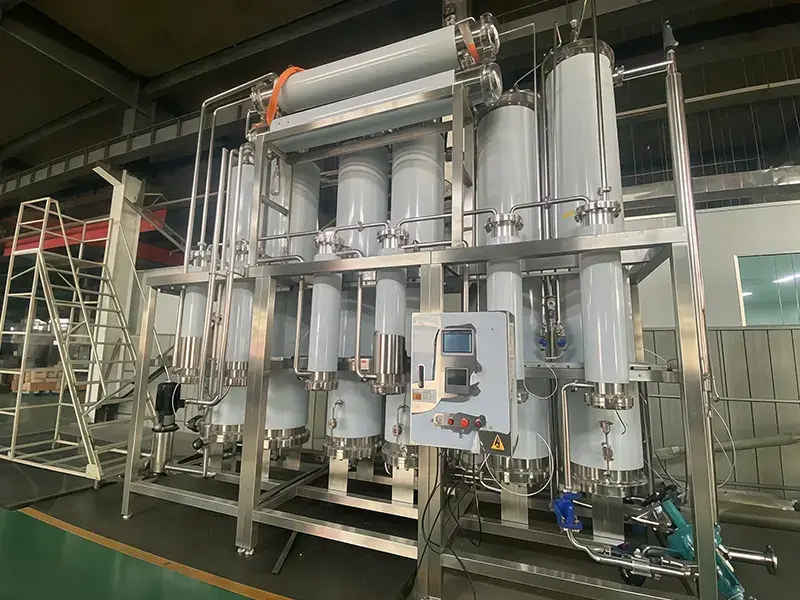
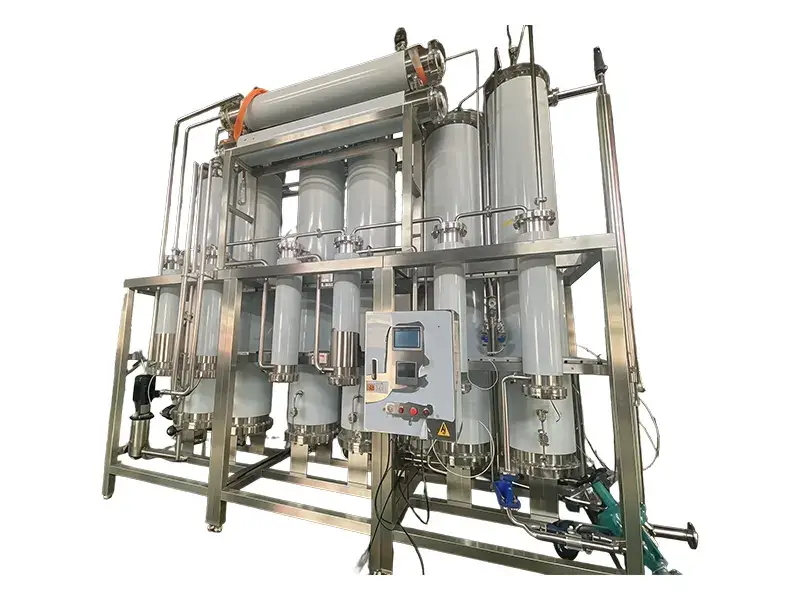
Multi-Effect Water Distiller (Multi-Effect Still)
Producing Water for Injection requires stable evaporation, efficient heat recovery, and reliable separation of pure steam from feed water. The multi-effect still is designed to convert qualified feed water into WFI through staged preheating, falling-film evaporation, steam-water separation, condensation, and online conductivity monitoring. This process helps pharmaceutical manufacturers achieve consistent WFI output while making better use of secondary steam and reducing unnecessary energy loss.
The multi-effect water distiller is designed to use purified water as feed water and industrial steam as the heat source to produce Water for Injection (WFI) with high-purity. The WFI produced fully meets the stringent requirements of the Chinese Pharmacopoeia (CP 2020), United States Pharmacopeia (USP 43), and European Pharmacopoeia (EP 10), making it suitable for a wide range of pharmaceutical applications.
- Qualified feed water is pressurized by a multistage pump and enters the condenser, where heat exchange begins. The feed water then passes through each preheater. In the condenser and preheaters, the feed water is heated by secondary steam, distilled water, and industrial steam condensate, helping recover heat from the process and improve overall energy efficiency.
- After preheating, the feed water enters the water distributor of the first-effect evaporator. The water is sprayed into the heating tubes and flows along the tube wall as a thin film. This falling-film evaporation process supports efficient heat transfer and stable steam generation.
- The secondary steam containing water droplets enters the steam-water separation device from the bottom of the heating tubes. After separation, the pure steam moves to the next effect as heating steam, while the unevaporated feed water continues to the next stage. This process is repeated across multiple effects, allowing secondary steam to be reused step by step.
- The pure steam from the final effect is combined with the condensed water from each stage, except the first effect. After cooling and removal of non-condensable gases, the resulting distilled water becomes Water for Injection. Depending on the model, the system can include a continuous discharge device for non-condensable gases.
- At the outlet, online conductivity monitoring checks the quality of the produced water. Qualified distilled water is delivered as WFI, while unqualified water is discharged, helping protect downstream pharmaceutical processes and support reliable water quality control.
| Model | Capacity (L/h) | Industrial Steam Consumption (L/h) | Feed Water Consumption (L/h) | Cooling Water Consumption (L/h) | Dimensions (mm) |
| |
≥100 | 30 | 110 | 80 | 1080×585×2800 |
| |
≥300 | 80 | 330 | 170 | 1760×755×3000 |
| |
≥500 | 115 | 550 | 190 | 2000×805×3500 |
| |
≥1000 | 250 | 1100 | 350 | 2300×1000×4000 |
| |
≥1000 | 210 | 1100 | 0 | 2930×1000×4000 |
| |
≥2000 | 440 | 2200 | 0 | 3650×1200×4100 |
| |
≥3000 | 670 | 3300 | 0 | 3800×1200×4200 |
| |
≥4000 | 900 | 4400 | 0 | 4300×1250×4500 |
| |
≥5000 | 1130 | 5500 | 0 | 4600×1400×4600 |
| |
≥6000 | 1350 | 6600 | 0 | 4600×1400×4900 |
- The external preheater, condenser, and first-effect evaporator use a dual-tube sheet design with tube expansion and external welding techniques. This prevents cross-contamination between utility fluids and process water.
- Equipped with a three-stage separation system, including falling-film evaporation, gravity separation, and helical swirling flow separation, ensuring high-purity steam output.
- All parts in contact with feed water, Water for Injection, and secondary pure steam are made from SS316L stainless steel, ensuring corrosion resistance and pharmaceutical-grade hygiene.
- Evaporators, preheaters, and condensers are insulated with aluminum silicate needle-punched blankets, offering excellent thermal performance, low weight, and high dimensional stability.
- Internal and external surfaces are electropolished to maintain a smooth, easy-to-clean finish that meets pharmaceutical standards.
- The multi-effect design reuses secondary steam across effects, achieving high steam utilization and significant energy savings. As the number of effects increases, energy efficiency improves, and cooling water usage decreases. Minimal cooling water is required for five-effect units, while six-effect units operate without cooling water.
- Stainless steel pipes are formed with direct stretch bending to minimize welds. Where welding is required, argon-protected automatic welding with single-side welding and double-sided forming is used. Welds undergo electropolishing for superior hygienic quality.
- Supplied with endoscopic inspection photos, weld point diagrams, pressure test reports, passivation records, and complete system design documentation for qualification and validation.
- Automated HMI+PLC control with a user-friendly interface and multiple communication options. At least three access levels can be configured to manage operator permissions.
- Real-time monitoring of conductivity, temperature, and flow. Data logging can be configured with either paperless or paper-based recorders to store and print critical parameters.
- Optional electronic signatures and electronic records enable full audit trail capability. The control system is designed to comply with GAMP 5 guidelines and 21 CFR Part 11 requirements.